
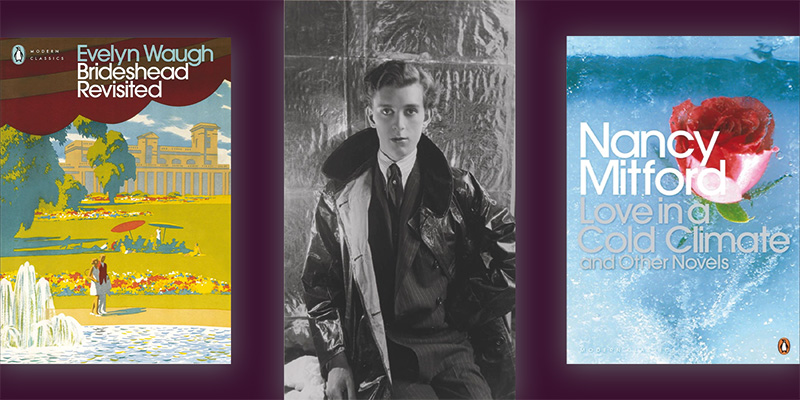
Probably the most unexpected influence on the writing of The Medway Wolf is Stephen Tennant — or, more properly, the Honourable Stephen Tennant — a minor and generally useless aristo who died in 1987.
I have no love of the British aristocracy, but I developed a fascination for the character after reading the fascinating biography of Tennant by Phillip Hoare in his book Serious Pleasures.
Stephen Tennant’s influence on The Medway Wolf was not direct or deliberate, but it proved to be lasting.
Beauty, Camp, and Survival in the 1920s
Tennant was part of the social set in the 1920s, known as the “Bright Young Things,” a group whose queer literary influence is still seen today. Due to his extraordinary beauty and flamboyant behaviour, Tennant was sometimes described as its brightest star. In truth, he sounds as camp as a row of pink tents, but let’s remember that being openly gay in the 1920s was something that could lead to either a prison cell or having your head kicked in.
Tennant’s principal achievement in life, it could be said, is that he somehow seems to have avoided both, and not only that, he became a major influence on the people around him.
The thing that Tennant is perhaps most famous for is his sexual relationship with the war poet Siegfried Sassoon that lasted for six years, until Tennant dropped him and left Sassoon devastated.
A Queer Muse in Art and Literature
Tennant, as I have said, left a deep impression on those around him, and among his friends was the photographer Cecil Beaton, who was responsible for a series of beautiful studies, such as the one in the featured image.
Tennant is also believed to be the model for the character of Sebastian Flyte in Evelyn Waugh’s Brideshead Revisited and Cedric Hampton in Nancy Mitford’s Love in a Cold Climate.
Although homosexuality was firmly suppressed, even ostensibly straight writers cannot do without us, and gay characters crop up from time to time, showing that we were there, even if mainstream society would prefer to pretend that we didn’t exist.
Sailors, Marseille, and Homoerotic Imagination
Being the subject of other writers’ work may have prompted Tennant’s own ambitions. And here, in case you were wondering, is the link to The Medway Wolf. Stephen Tennant’s influence on my writing was indirect, but persistent.
Tennant planned to write a novel of his own entitled Lascar, a Story of the Maritime Boulevards. A lascar, for those of you not familiar with the term, is a sailor from India or Southeast Asia. The novel would have been set in Marseilles.
The image of burly sailors hanging around the streets of this port town has clear homoerotic overtones, and I don’t doubt this would have appealed to Tennant as much as it appeals to me.
As soon as I read the title, I knew I wanted to read it.
Unfortunately, although Tennant laboured on it for some fifty years, he never finished his book. A lesson for aspiring writers there, I think. And I was left wondering how the book might have turned out.
Crime, Sailors, and the Dark Underside of Port Cities
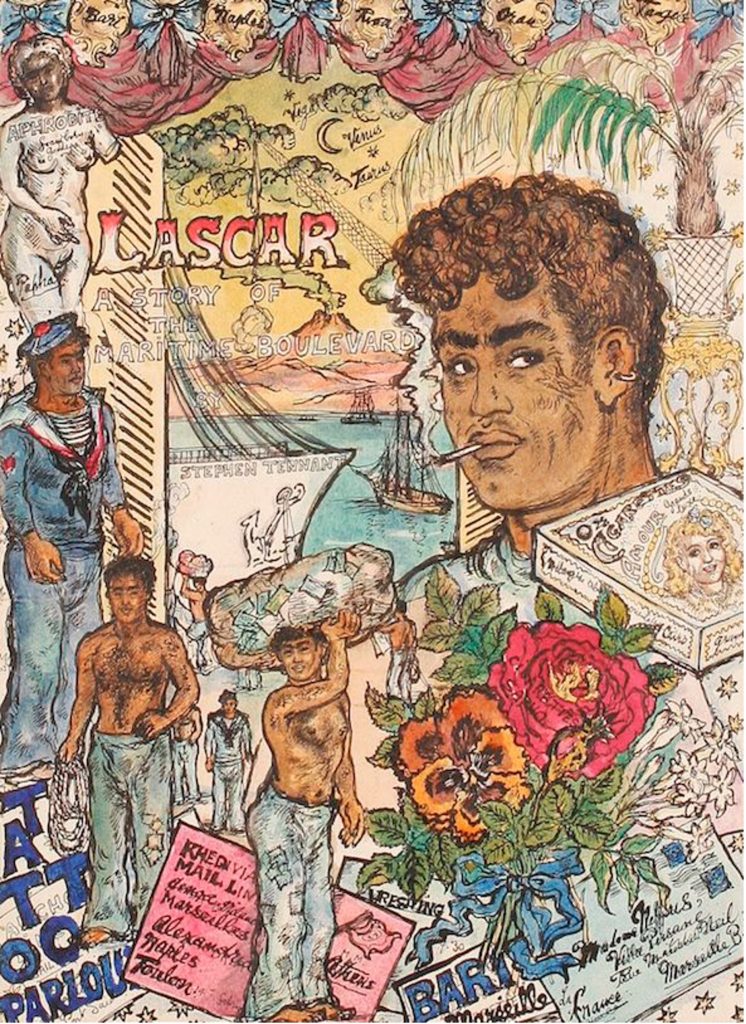
This sketch, which Tennant created for his project, suggests that the plot may have been akin to Genet’s Querelle de Brest, in which the sailors are linked to crime and the dark underlife of the city.
Although I’m unable to read Lascar, the thought lit a spark that loitered idly in my own imagination like some dockyard hustler for nearly forty years since I first heard of it in the 1980s.
I have never visited Marseille or Brest, but a visit to my hometown of Chatham on the Medway brought to mind that all port cities have a similar reputation. Where you find sailors, you will find alcohol, prostitution (male and female), and fighting.
Chatham’s dockyard is sadly now long closed, and much of what gave the town its reputation for being a bit rough has also now passed. But like Genet, these tales inspired a kind of inverted glamour that I knew I wanted to use as the background for my next story.
The Medway Wolf as Queer Gothic Fiction
I doubt very much that Stephen Tennant would have thought of having Marseille inhabited by werewolves. But werewolves are creatures that shun the light of day and inhabit the seedy underbelly of the city, just as Crowe and Aaron do in Chatham.
Remembering Stephen Tennant
Forty years after his death, it seemed fitting that I named the two prison ships The Lascar and The Stephen, in acknowledgement that this long-forgotten queer can still be an inspiration. This is how literary influence often works: Stephen Tennant’s influence travelled indirectly, through images and atmosphere rather than finished work.
Tennant never finished his novel, and I didn’t try to finish it for him. But I took from it what he left behind: a fascination with sailors, shadows, and the dangerous glamour of port cities after dark.
No book is written in isolation, and that fascination found its way into The Medway Wolf, shaped by earlier writers and queer literary influences that continue to surface in new forms. Every story grows out of earlier ones, finished or not, passed on through images, ideas, and half-remembered fascinations. I only hope you think I did those ideas justice.
Leave a Reply